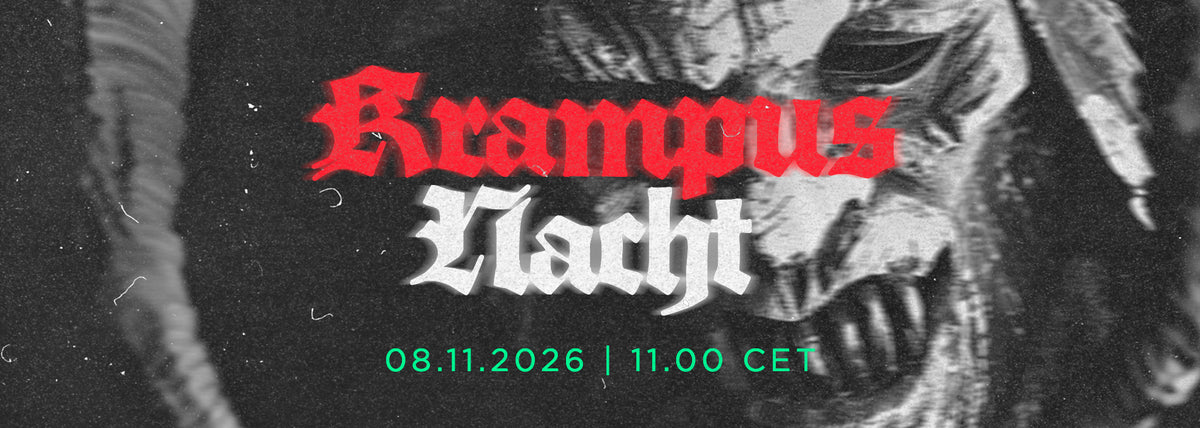
Later, no one could say with any certainty when a Krampus had first walked the streets of Klammbach.
The oldest parish registers did not mention the custom. That surprised no one in particular. Priests wrote down births, marriages, deaths and occasionally things that later priests would come to resent. Which farmhand hung a pelt over his shoulders at the start of December and made the village children cry from beneath a carved grimace was rarely among them.
The masks were old all the same.
For most of the year they hung in the workshop of Johann Gruber. He carved saints for chapels, mended chair legs and in November made faces he was paid for by the very people who complained a few weeks later about how hideous they looked.
Johann took that as a sign of good work.
The oldest mask hung a little apart. Over the years its wood had turned almost black, the brow was broader than on the newer masks, and at the root of the left horn a dark iron band lay over an old repair. Johann's father had worn it, and before him supposedly his uncle. Further back the tradition grew unreliable, but Johann saw no great problem in that.
Good stories last longer than receipts.
Klammbach lay in a narrow valley through which traders, carters and cattle passed in summer. In winter that changed. The snow ate the pass first, then the road to the next larger town and eventually the last topics of conversation as well. By December, whoever lived there usually knew fairly precisely who owed whom money, which farmhand climbed out of which window at night and whose larder was emptying surprisingly fast.
In Klammbach, secrets did not get far.
On 5 December, by tradition, they got even less far.
That evening several Krampuses made their way through the village. At some point St Nicholas joined them, accompanied by a church helper and occasionally two men whose most important task was to make sure the younger Krampuses did not get too much schnapps before the third house. For generations the order had never mattered much. Some years the saint walked in front, sometimes he lost half his escort in the snow, and at least once he is said to have reached the lower village a quarter of an hour after the Krampuses, because the man under the mitre had stopped at the inn for a bowl of soup.
No one had ever seen a theological problem in this.
Until Pfarrer Steiner came to Klammbach.
Steiner was tidy, educated and convinced that things improved once they were put in their proper place. His books stood sorted by size, his vestments hung by colour, and he even had the candle stubs collected in separate boxes, because in his view spent wax also deserved a sensible order.
He had trouble with the Krampuses from his very first winter. While St Nicholas walked the streets, young men drank beneath devil masks, chased girls across the square, struck shutters with their rods and behaved for a few hours the way young men traditionally behave when they are told that for one evening they are not themselves. What bothered Steiner was less that the custom was old than the fact that of all things the devil had become the most popular part of it.
In his second winter he preached against it. In his third he tried to introduce rules, which held roughly until the first schnapps. After that, the whole affair might well have carried on like this for years, had a purse of money not disappeared from the church the following October.
Several families had collected coins for two widows and their children. After Sunday mass the purse lay in a small cupboard behind the sacristy, to be handed out the next morning.
When Steiner opened the cupboard, it was empty.
Several people had had access. Among them were two boys who had helped tidy up after mass: Jakob Seidel and Martin Aigner.
Martin was the son of Josef Aigner, the largest timber merchant in the valley. Aigner also owned two wagons, the inn on the market square and enough promissory notes to sit at the table, at least indirectly, for almost every decision made in Klammbach.
Jakob's father, on the other hand, had died three years earlier beneath a falling trunk.
Martin said Jakob had gone back into the sacristy alone after mass. Jakob said that was not true. The church helper remembered nothing, and at first neither did Lehrer Eder. Josef Aigner, by contrast, reminded everyone that his son received more pocket money at home than had ever been in the purse.
That was no proof.
In Klammbach it was enough all the same.
Jakob stuck to his story. Even after Steiner had called him in twice, he did not change a word. In the end his mother offered to work off the missing sum over months if only that would bring some peace. Jakob grew so furious that for the first time in his life he shouted at his mother, and after that half the village talked less about the theft than about his lack of remorse.
At the end of November someone at the inn said the boy would confess soon enough once a mask was standing at his door on Krampus night.
Josef Aigner heard it.
The next morning he was sitting with Steiner.
Aigner suddenly had the same misgivings about the custom as the priest, only for a different reason. Masked men, he explained, surely could not turn village rumours into a verdict. What would happen if the wrong boy were punished? What if someone settled a personal score from beneath a mask?
Steiner needed little persuading.
That same day he stood in Johann's workshop and told him that this winter Klammbach would manage without Krampus.
Johann was sanding a piece of wood and at first simply kept working.
“Entirely without?”
“Entirely without.”
“Well, at least you'll save on bells.”
Steiner explained that the St Nicholas custom was finally to return to its true meaning. No more devil masks, no horns, no chains and above all no men hiding under fur who claimed the next morning not to remember who had lifted an inn door off its hinges in the night.
“We don't need a devil to teach children what is right.”
Johann put down his tools.
“You've needed him for a long time.”
“We have tolerated him.”
Johann looked at him for a moment.
“People like to say that about things that have been around longer than they have.”
Steiner left the workshop with the same conviction he had brought into it.
For the new St Nicholas evening, Lehrer Eder was to keep a book. Parents could tell him what had happened over the past year, and Eder would note down only what he found credible. Steiner would then review the entries and read from them on his round.
Johann was invited to a meeting, mainly so that he could be told officially that his masks would not be needed this year. The empty book already lay on the table in front of Eder.
Johann looked at it for a while.
“Who writes?”
“Eder.”
“Who checks?”
“I do,” said Steiner.
“And who decides what is true?”
“All of us. In good conscience.”
Johann nodded slowly.
“Then you've finally found something more dangerous than a mask.”
Josef Aigner laughed.
No one else did.
From that day on the book lay on Eder's desk, and people got used to it remarkably quickly. Next to most names stood harmless things: stolen apples, skipped lessons or a broken windowpane whose blame had been passing back and forth between two brothers since spring. One girl had taken a piece of sausage at the butcher's and later claimed the dog must have done it, although the dog in question had been dead for two years.
Then Josef Aigner came.
He closed the door behind him.
No one heard the conversation.
That evening, next to Jakob Seidel's name, it said:
Took money from the church and did not confess despite repeated requests.
Next to Martin Aigner's it said:
Diligent. Helpful. Honest.
Eder sat in front of the two entries for a long time before he closed the book.
On 5 December it had been snowing since early afternoon.
For the first time Johann could remember, his workshop stayed silent that day. No young men came to collect pelts, no one argued over whom which mask suited better, and the heavy bells lay untouched in a chest against the wall.
In the evening Johann took the oldest mask from its hook. He ran his thumb over the iron band on the horn, laid the mask with the others and pushed the pelts over them. Then he locked the chest.
He put the key in his pocket.
Outside, St Nicholas began his round.
At first everything worked splendidly. Children recited poems, parents smiled, Steiner read from Eder's book and handed out nuts, apples and biscuits. No Krampus struck a doorframe with his rod, no bell interrupted a recitation and no one had to drag a drunken man in fur out of a front garden.
At the Aigners', Martin received a packet of candied fruit.
Steiner praised his honesty.
Martin looked at the floor.
Then they went to the Seidels.
Jakob's mother had cleaned the parlour, although there was hardly anything in it that could have been moved. Jakob sat at the table and stayed seated when Steiner came in wearing his St Nicholas robes.
The priest opened the book and read the entry.
“Do you have anything to confess?”
“No.”
Steiner explained to him that a lie only makes a mistake bigger.
“Then it must be enormous by now,” said Jakob.
His mother reached for his arm.
Steiner pointed to the book.
“It is written here.”
Jakob looked at the empty place beside him, where in any other year a dark figure would have stood.
“Then ask the Krampus.”
Steiner closed the book.
“The Krampus decides nothing.”
Jakob looked at him.
“But you do, apparently.”
After that he got nothing.
Shortly after nine, Johann heard the first bell.
It was no small string of jingle bells. The largest of his Krampus bells had a fine crack in the metal and therefore sounded deeper than the others. Johann had often thought about replacing it and never had.
Now it was striking somewhere above the village.
Johann reached into his pocket.
The key was still there.
He went to the chest.
The lock hung on it undamaged. He pulled at it, tested the bolt and finally opened it with the key.
On top lay the pelts.
Beneath them the rods.
Most of the masks lay exactly where he had put them.
The old black mask was missing.
With it, the cracked bell and the longest chain had disappeared.
Johann stood for a moment in front of the open chest. No window in the workshop was open, the back door was bolted from the inside, and the only key had been in his pocket the whole time.
Then the bell struck again.
Closer this time.
Johann put on his coat and went out.
When he reached the square, people were already standing in their doorways.
Between the houses, something large was moving.
At first Johann saw only the fur, then the horns and finally the old mask with the iron band at the left root. With every step the cracked bell struck deep against the figure's hip. The long chain dragged behind it through the snow.
No one was holding the other end.
The Krampus did not go to the houses.
It went to the presbytery.
Steiner, still in his St Nicholas robes, stood in front of the door. He carried the book under his arm.
“Stop.”
The figure stopped.
Steiner looked around the circle of people as if expecting someone somewhere to laugh at the successful prank.
No one did.
“Who's under there?”
The Krampus did not answer.
Steiner took a step closer.
“Who sent you?”
Nothing again.
Then his eyes fell on the mask.
“The custom is over for this year.”
The Krampus held out its hand.
Not for Steiner.
For the book.
The priest held it tighter.
“This is none of your business.”
The figure waited.
At some point Steiner's grip turned into something that was harder and harder to explain in front of the whole village. In the end he handed over the book.
The Krampus did not open it.
It did not look at a single name.
It carried it across the square to an iron brazier in front of the inn, where scraps of wood had been burning since the afternoon. Only a few logs were still glowing in it.
Johann followed.
So did the others.
The Krampus threw the book into the fire.
Eder let out a sound and took a step forward, but stopped as the first pages began to curl. Josef Aigner demanded that someone pull the book out. Steiner said nothing at all.
The Krampus did not wait to see whether anyone obeyed.
It turned away and walked on towards the church.
Behind it, Martin Aigner began to cry.
At first so quietly that only his father noticed. Josef grabbed him by the arm and said something that was lost among the crowd.
Martin tore himself free.
“I took the money.”
The Krampus was already several steps away.
It did not stop.
Martin said it again, louder this time.
“I took it.”
Now the whole square heard it.
Josef reached for him again, but the boy backed away and kept talking. He told them about the market, about the older boys who had been throwing dice for money, and that he had meant to put the coins back later. When the purse was missed, he had grown afraid. Then Jakob was suspected, and after that all Martin had to do was keep quiet.
People turned towards Josef.
Others towards Eder.
Some looked for Jakob in the crowd.
The Krampus walked on.
No nod.
No glance back.
Not even the bell struck.
What Martin had said belonged to them.
In front of the church the figure stopped.
The chain still lay behind it in the snow.
Steiner had broken away from the crowd and followed it.
“What do you want?”
The Krampus looked at him.
Steiner pointed back to the square, where the pages of the book were burning by now.
“What was that supposed to be?”
No answer.
The priest grew louder.
“This is God's house.”
The Krampus took hold of the chain.
For the first time since it had appeared, it took the chain off its body entirely.
It held it in both hands, looked at it briefly and struck it against the stone frame of the church door.
The first time nothing happened.
At the second blow, sparks flew from the stone.
At the third, a link broke.
The chain fell in two pieces at Steiner's feet.
No one picked it up.
The Krampus opened the church door and went inside.
Johann followed as far as the entrance, but stopped there.
Only a few candles were still burning in the nave. The figure walked down the centre aisle and stopped before the altar.
There it took off the mask.
From the door Johann could only make out that the black mask was suddenly resting in two hands.
The Krampus set it on the lowest step of the altar.
Exactly where people otherwise knelt.
Steiner stepped into the church.
Slowly he walked down the centre aisle.
When he was only a few steps away, the figure turned towards him.
Steiner stopped.
Later, Johann once asked him what he had seen in that moment.
The priest did not answer.
That night he said nothing more about it at all.
After a while the figure picked up the mask again and put it back over its face. Then it walked past Steiner, down the centre aisle and out into the snow.
No one tried to stop it.
The bell struck once more as the Krampus reached the upper end of the village.
Then the sound vanished.
Later, people searched for tracks. In the fresh snow the path could easily be followed as far as the last house.
Beyond it there was nothing.
The next morning Johann went into his workshop.
The lock on the chest was closed.
He still had the key in his pocket.
When he unlocked it, the old black mask lay among the others.
The pelt was folded beneath it.
The cracked bell stood beside it.
Only the chain was missing.
Its two pieces still lay in front of the church.
The book was never replaced.
Not because Steiner had expressly forbidden it. No one wanted to keep a second one.
Martin had confessed, and so everyone in Klammbach knew that Jakob had not taken the purse. That did little, however, to change how quickly almost all of them had been ready to believe the other version. Eder no longer spoke of what Josef Aigner had said in his house that evening. Josef, for his part, told anyone who asked that he had forced the teacher into nothing.
Steiner remained priest.
Johann, too, stayed with his masks.
The following December the old black mask hung in its place in the workshop again.
As 5 December drew near, the young men turned up at Johann's as they always had. No one had officially permitted the custom again. There was no assembly and no decision about it. They simply came.
Johann handed out the pelts.
The bells as well.
Only with the old mask did he hesitate.
In the end it was worn too.
Who was beneath it was never written down again.
In the years that followed, the memory of that night blurred in some places and grew all the sharper in others. Some eventually claimed that Johann himself had worn the mask back then. Others said that could not be true, because they had seen him on the square beside them. Others again considered the whole story an invention that had grown a little bigger with every winter.
Johann took no part in these discussions.
Once a young man asked him why he never said who the Krampus had been that night.
Johann replied that he would have to know it first.
After that there were winters in which the old mask was clearly worn on the run.
There were others in which no one took it.
And there were at least two years in which Johann later insisted it had hung in his locked workshop the entire evening, although several people in the upper village swore they had heard the cracked bell.
In time Klammbach learned to let these contradictions stand.
St Nicholas kept coming.
So did the Krampuses.
Only the book never came back.
And when, late on the night of 5 December, a single deep bell struck once more somewhere above the houses, no one asked any longer whether the run had not long since ended.
And ever since, it has been written in Klammbach:
YOU CAN STRIKE KRAMPUS FROM THE CUSTOM. NOT FROM THE NIGHT.